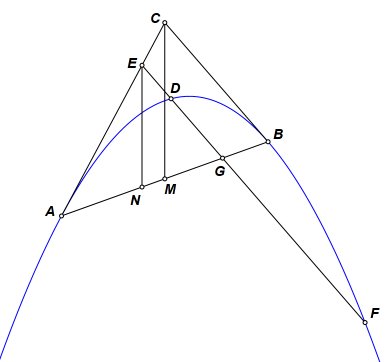
Parabola 10 Support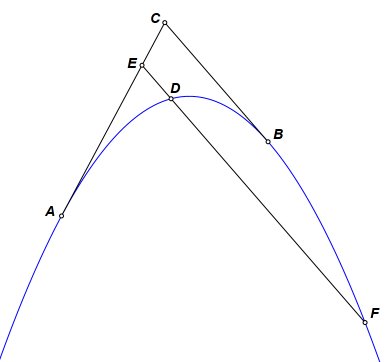 Begin with Apollonius’s Conica (III.16). The author was not showing a construction, but rather proving a proposition that has been useful here. Let CA and CB be tangents touching a parabola at A and B, and let EDF be a line parallel to CB, meeting CA at E, and the parabola at D and F. Then this relationship must follow: 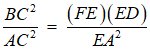 Note now that (FE)(ED) is the square of the geometric mean of FE and ED. Let EG be that geometric mean, where G lies between D and F. 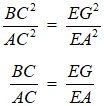
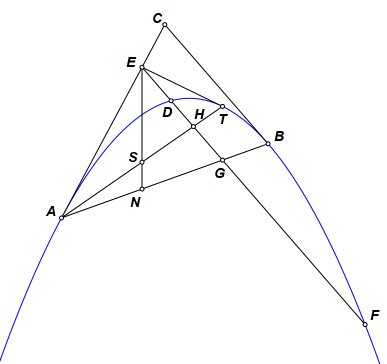
Let M be the midpoint of AB, which makes CM a diameter. Let N be the midpoint of AG. Following the similarity of ΔAEG and ΔACB, medians EN and CM are parallel, so EN is also a diameter. Let ET be a tangent touching the parabola at T. Let AT intersect EN at S, and EF at H. Therefore, S is the midpoint of AT, and EH divides DF harmonically. Back to the construction at hand, suppose we are given only points A, D, and F, and the tangent line through A. From that it is possible to construct intersection E, the geometric and harmonic division points G and H, and continue on to the point of tangency T. At that point we would have the tangents EA and ET, and the construction is nearly complete. See Parabola 5. There is a second solution though. The above construction supposes that the second tangent line, CB, and the secant line, DF, fall on the same side of point A. Remember that the parabola itself was not given, so what if the second tangent line falls on the other side of A? Here is the second possibility. 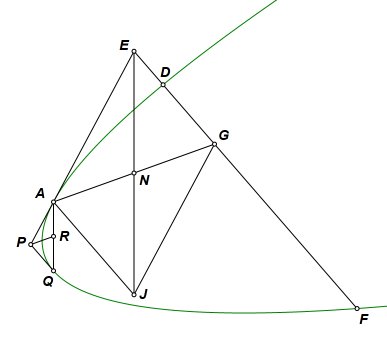 Again citing Conica (III.16), tangent PQ has these properties: 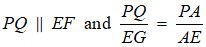 Let AJ be parallel to EG, with J lying on EN produced. Hence, ΔAPQ ~ ΔEAJ. Let R be the midpoint of AQ, which makes PR a diameter. Working from the similar triangles, PR is parallel to AG, which means the previously constructed AG establishes the diameter direction. Backing up again, let K be the midpoint of chord DF. Let KUL be parallel to AG, intersecting AJ at U, and AE at L. Line KUL is a diameter bisecting chord DF, so it must also bisect the parallel chord through A. Let AU be produced to V, such that U is the midpoint of AV. It follows, now, that LA and LV are tangents touching the parabola at A and V. Those two tangents are sufficient for the construction of the parabola, as described in Parabola 5. 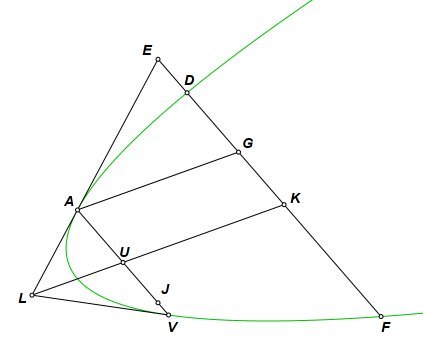 Last update: October 14, 2026 ... Paul Kunkel whistling@whistleralley.com |